


Blog
Why Do People Wear Chicken Hats at Oktoberfest? The Ultimate Guide to Munich’s Quirkiest Festival Tradition


If you’ve ever scrolled through social media feeds in late September, you’ve likely seen the images: crowds of joyous festival-goers in Munich, clutching liter-sized steins of beer, dressed in traditional lederhosen or dirndls. But look a little closer at the sea of heads, and you might notice something peculiar bobbing among the alpine fedoras and flower crowns. It’s a plush, roasted chicken, legs splayed, sitting squarely on someone’s head.
This is the Hendlhut, or “chicken hat,” and it has become one of the most polarizing yet popular accessories at Oktoberfest. For the uninitiated, it looks like a fever dream—a golden-brown rotisserie bird that sometimes dances or claps its tiny drumsticks together. It seems completely at odds with the centuries-old traditions of Bavarian culture, yet tens of thousands of them are sold every year.
So, how did a plush poultry hat become a staple of the world’s largest folk festival? The answer isn’t just about silly souvenirs; it is a strange collision of culinary obsession, catchy 1980s pop music, and the global tourism boom. Whether you view them as good fun or a tacky tourist trap, the chicken hat tells a fascinating story about how modern Oktoberfest has evolved from a royal wedding celebration into a global party.
Anatomy of a Trend: What is the Hendlhut?
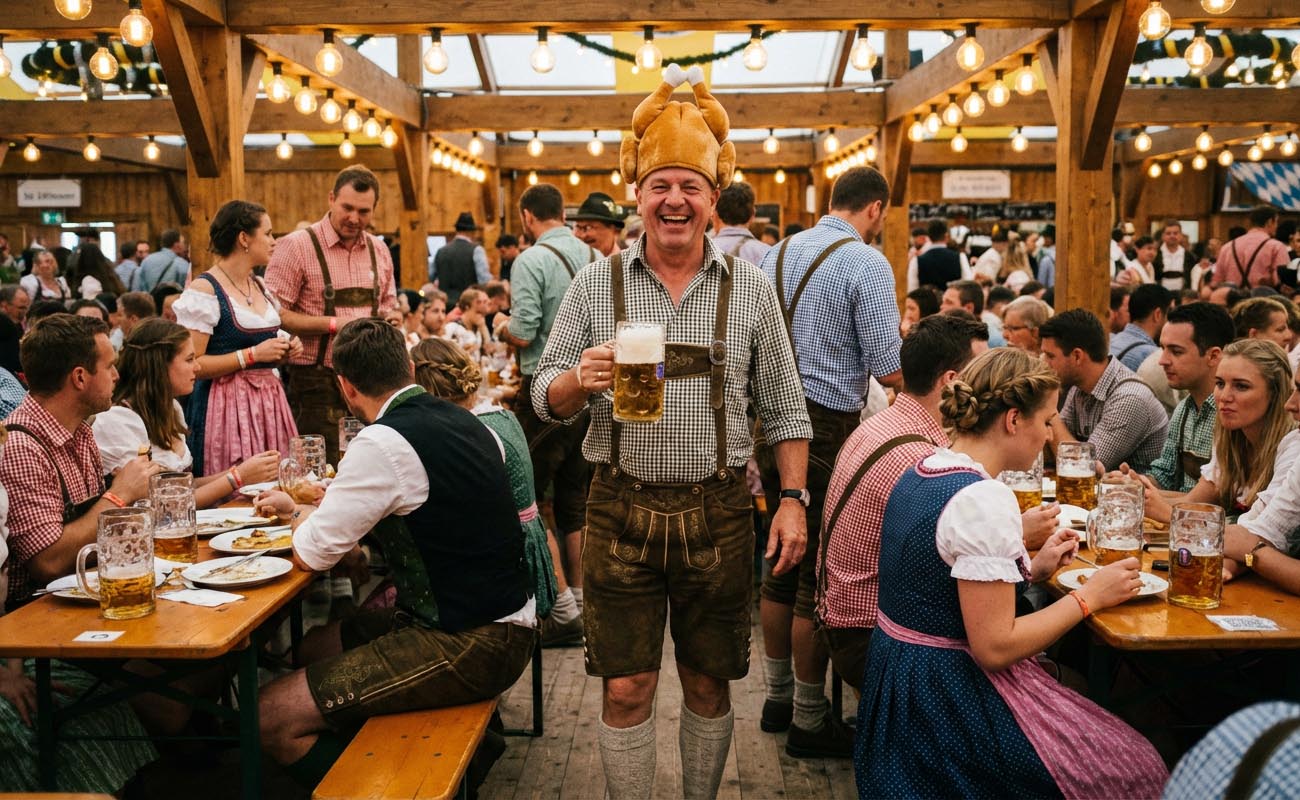
The Hendlhut is exactly what it sounds like—a hat shaped like a Hendl, the Bavarian term for a roasted chicken. Unlike traditional Bavarian hats (Tirolerhüte), which are made of felt and adorned with a Gamsbart (a tuft of chamois hair), the chicken hat is pure novelty. It is typically made of soft, plush material designed to look like a golden-brown, oven-roasted bird.
Most versions feature the chicken upside down, with its body covering the wearer’s head and its legs sticking up into the air. More advanced versions are interactive. With the press of a button or a squeeze of a dangling cord, the chicken legs kick or clap, often accompanied by a battery-operated screech or a tinny rendition of the “Chicken Dance” song.
While official Oktoberfest souvenir shops sell them, they are often hawked by street vendors and pop-up stalls surrounding the Theresienwiese (the festival grounds). They are undeniably silly, bright, and impossible to miss—which is exactly why they appeal to festival-goers looking to stand out in a crowd of millions.
The Culinary Connection: The Hendl
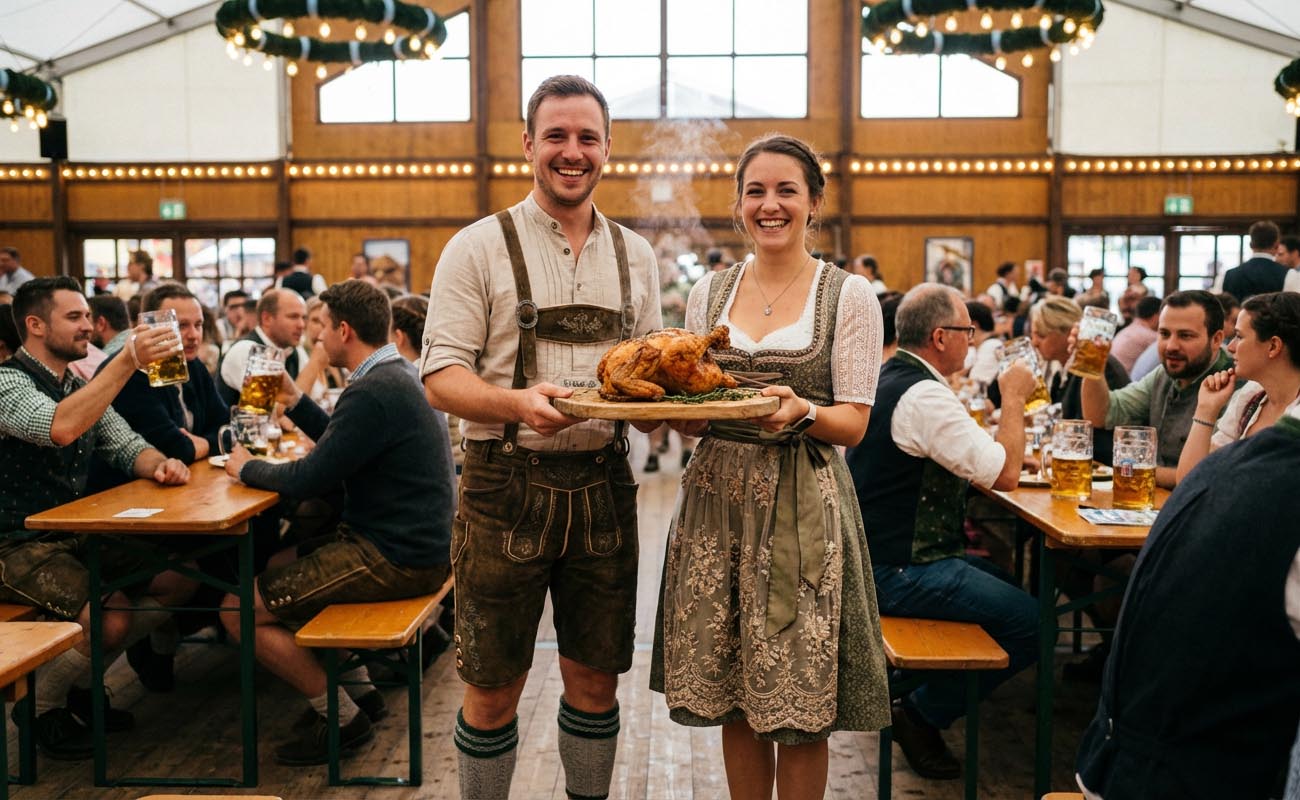
To understand the hat, you first have to respect the bird. While beer is the undisputed king of Oktoberfest, the Wiesn-Hendl (Oktoberfest roast chicken) is the queen. It is the most consumed food item at the festival, outpacing sausages and pretzels by a significant margin.
A feast by the numbers
The sheer volume of chicken consumed in Munich during the 16-day festival is staggering.
- Consumption: On average, visitors consume around 400,000 roast chickens every year.
- Preparation: The chickens are traditionally seasoned with salt and parsley, sometimes butter, and roasted on massive spits until the skin is crispy and brown.
- Service: They are typically served as half-chickens (halbes Hendl) alongside a massive potato dumpling or potato salad.
The chicken is such an integral part of the sensory experience of the Wiesn—the smell of thousands of birds roasting fills the air inside the beer tents—that it was only a matter of time before it migrated from the plate to the gift shop. The hat serves as a wearable tribute to this culinary icon. Just as tourists might wear cheesehead hats in Wisconsin to celebrate local dairy culture, international visitors in Munich wear the Hendlhut to pay homage to the delicious bird that fuels their marathon drinking sessions.
The Soundtrack of the Hat: The Chicken Dance
You cannot talk about the chicken hat without talking about the song that likely inspired its kinetic features. If you have been to a wedding, a bar mitzvah, or an Oktoberfest celebration anywhere in the world, you know the “Chicken Dance.”
Originally titled Der Ententanz (The Duck Dance), the melody was composed in the late 1950s by Swiss accordion player Werner Thomas. It was a catchy, repetitive tune, but it didn’t become a global phenomenon until the early 1980s. When a Dutch band called Electronica released an instrumental version, it exploded across European charts.
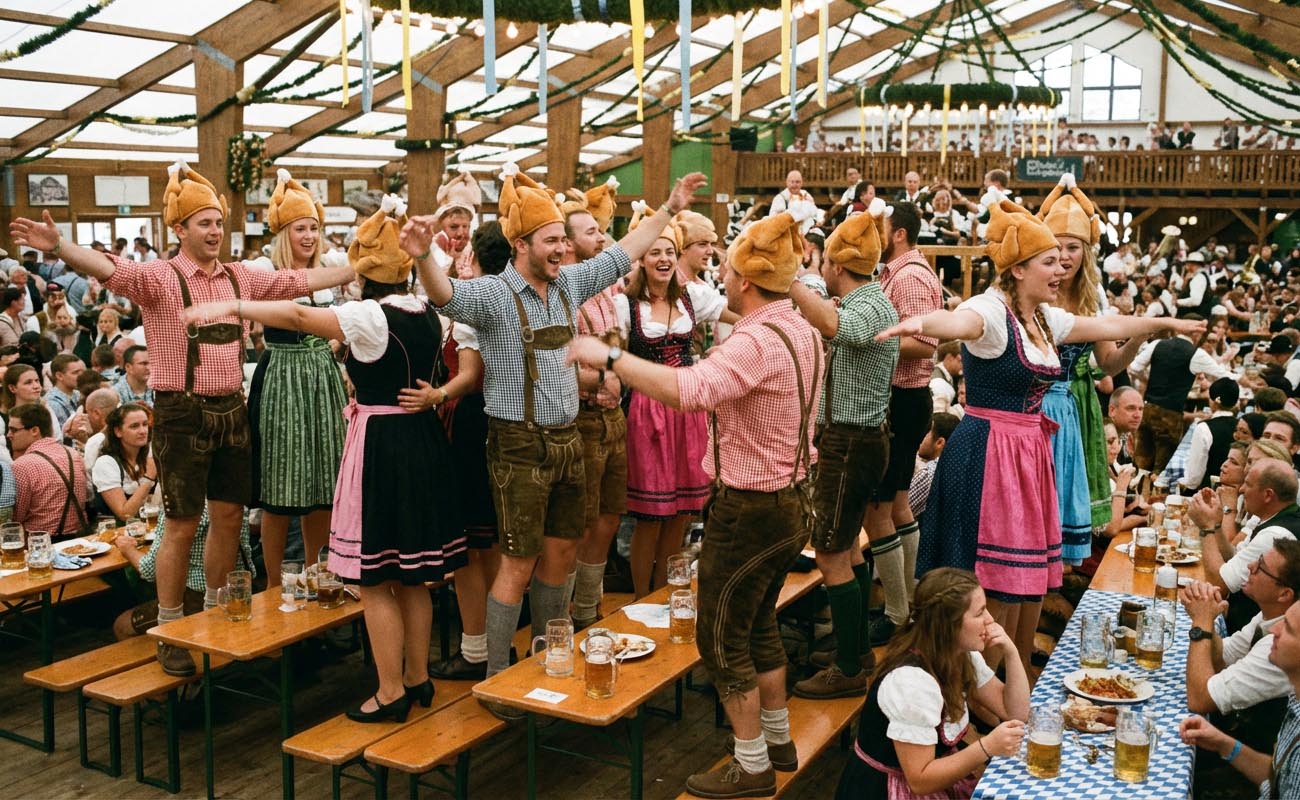
By the time the song reached the beer tents of Munich, it had morphed from a duck dance into a chicken dance. The accompanying dance moves—making beaks with your hands, flapping your arms like wings, and wiggling your tail feathers—became a communal ritual. When the Oompah bands strike up the opening chords, thousands of people stand on their benches to perform the synchronized dance.
The Hendlhut is the physical embodiment of this ritual. It captures the silliness and the communal joy of the “Chicken Dance.” Wearing the hat signals that you are ready to participate, that you know the moves, and that you don’t take yourself too seriously. It transforms the wearer from a passive observer into an active participant in the festival’s most famous musical tradition.
A Tale of Two Origins: Munich vs. Cincinnati
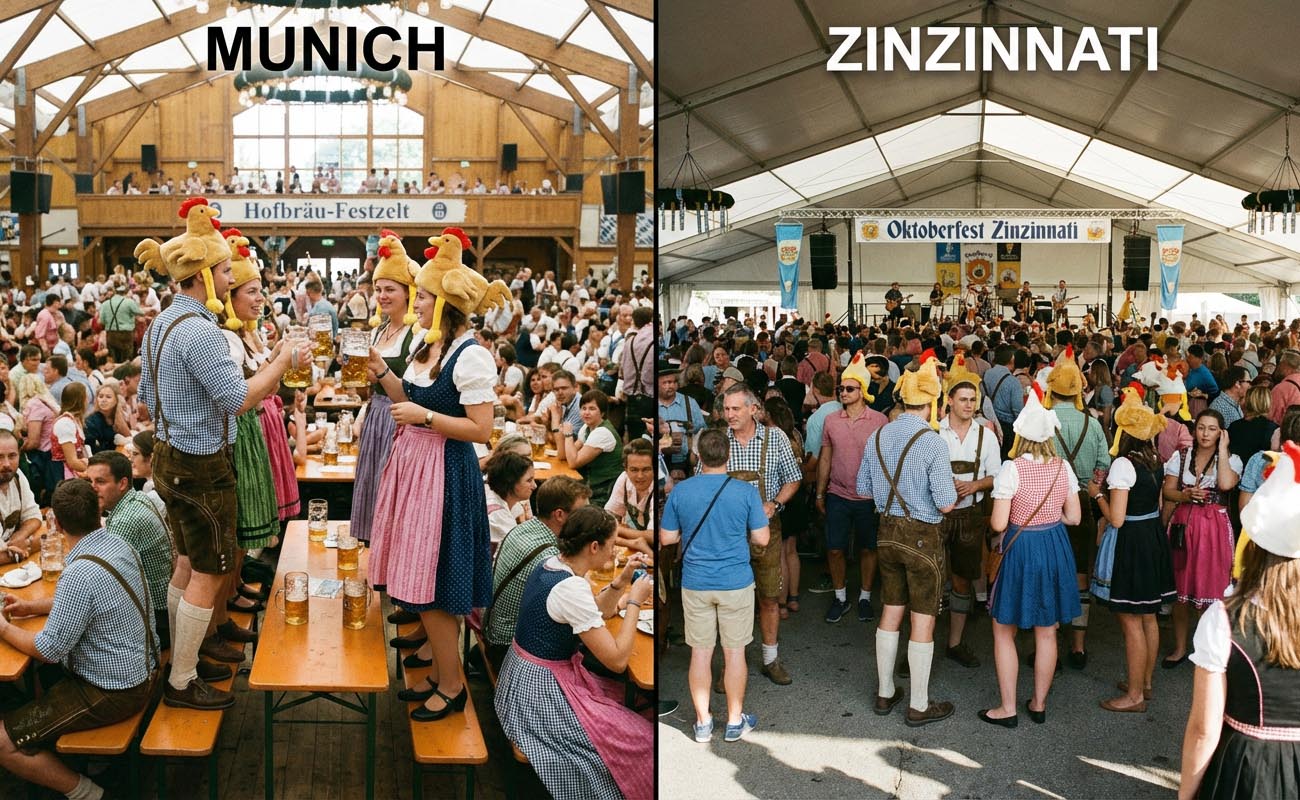
While the Hendlhut is now a fixture in Munich, its exact origin story is a bit murky, with a surprising claim coming from across the Atlantic.
The Munich adoption
In Munich, the hat appeared relatively recently in the long history of the festival. Official Oktoberfest guides note that the hat has been sold for “several years” and has become a staple for international guests. It likely evolved naturally as souvenir vendors looked for new ways to capitalize on the popularity of the Wiesn-Hendl and the “Chicken Dance.” It fits perfectly into the European tradition of Carnival (Fasching), where dressing up in silly costumes is encouraged.
The “Chicken Man” of Cincinnati
However, a strong claim to the chicken hat throne comes from Cincinnati, Ohio, home to “Oktoberfest Zinzinnati,” the largest Oktoberfest celebration in the United States. John Harrell, known locally as the “Chicken Man,” claims to have popularized the chicken hat trend starting in 1996.
According to Harrell, he was inspired after doing the Chicken Dance on stage at an Oktoberfest in Texas in the early 90s. He went home, crafted a felt chicken hat with googly eyes, and wore it around town. The response was so positive that he began manufacturing them. Initially, organizers in Cincinnati were skeptical, unsure of what a chicken hat had to do with German heritage. But after Harrell sold out of his stock from a folding table on a side street, they invited him in. He has since sold tens of thousands of hats, becoming a local legend.
Did Harrell’s invention migrate to Germany, or did Munich vendors come up with the idea independently? It’s a classic case of parallel invention. What is clear is that the appetite for poultry-themed headwear is global.
Locals vs. Tourists: The Great Divide
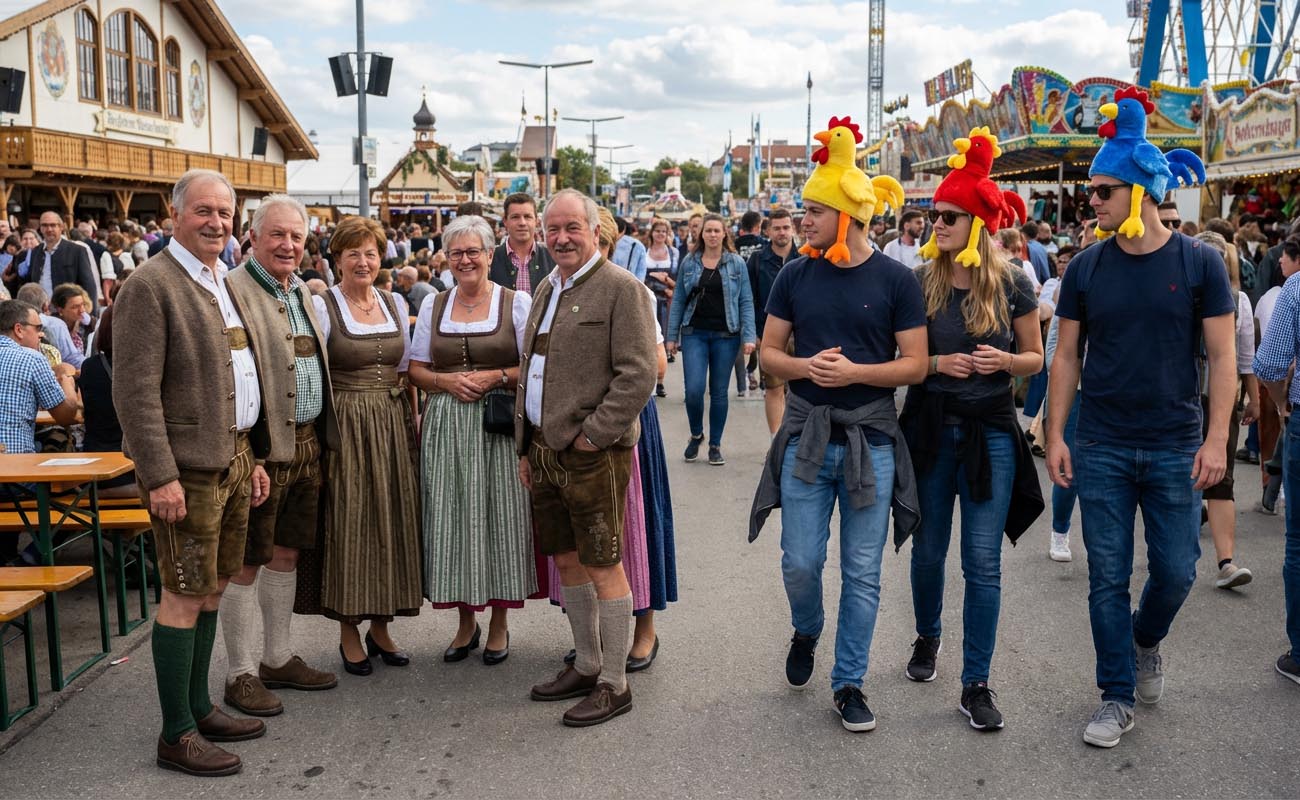
If you want to spot a tourist at Oktoberfest, don’t look at their shoes—look at their head. The Hendlhut serves as a fairly reliable cultural litmus test on the festival grounds.
For the most part, Munich locals (Münchner) and traditional Bavarians rarely wear them. For them, Oktoberfest is a celebration of heritage. They invest hundreds, sometimes thousands, of Euros in authentic Tracht (traditional clothing). A high-quality Dirndl made of silk or linen, or a pair of deer-leather Lederhosen passed down through generations, is a point of pride. Topping such an outfit with a cheap, battery-operated plush toy is seen by purists as a fashion crime, or at least a major faux pas.
However, this doesn’t mean locals hate the hats. Munich is a city that knows how to host a party, and the locals are generally tolerant of the “Oktoberfest kitsch” that tourists enjoy. The official Oktoberfest website even acknowledges the hat with a winking tone, noting that while it “divides opinion,” it is a “good idea” if you simply want to be funny.
For tourists, especially those from Australia, the United States, and the UK, the hat is a badge of honor. It signals that they are there to party. It breaks the ice. It is a souvenir that says, “I went to Munich, I drank the beer, and I have the ridiculous hat to prove it.”
Guide to Oktoberfest Headwear (Dos and Don’ts)
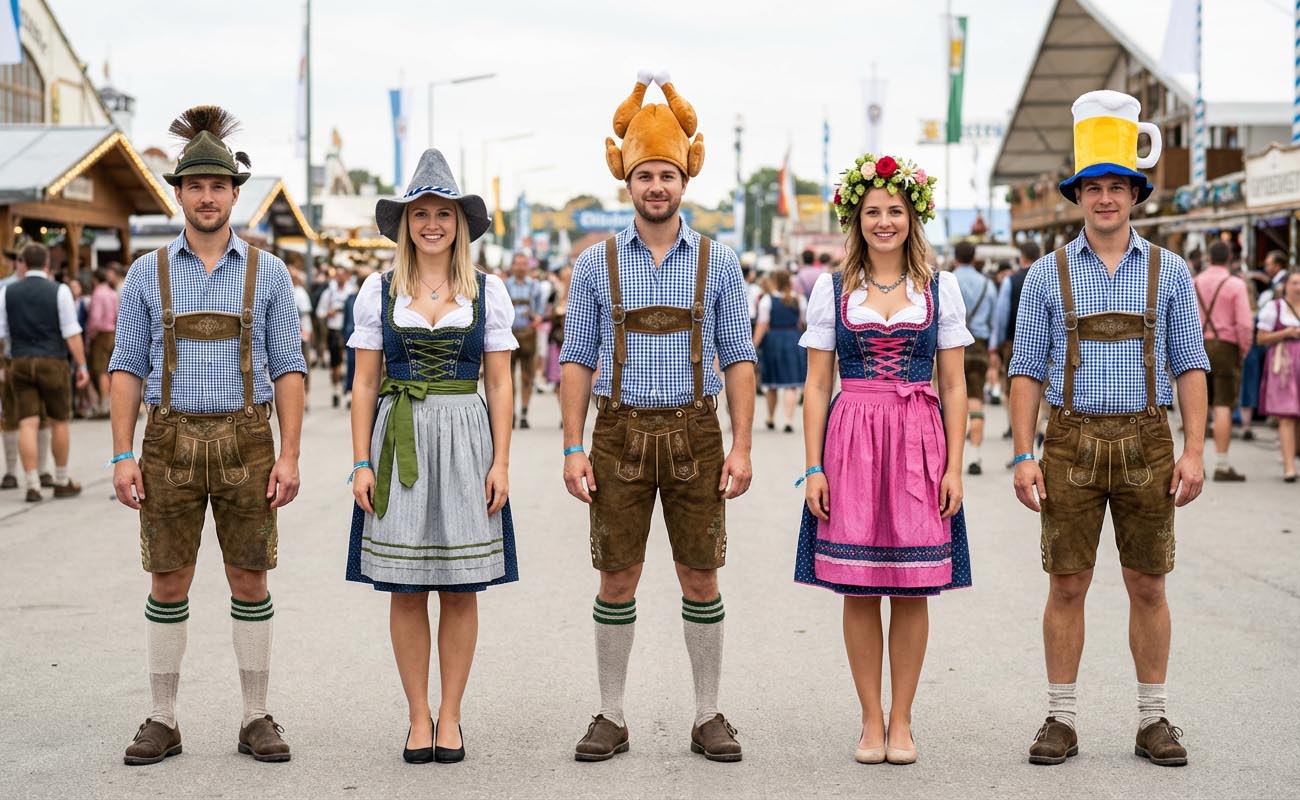
If you are planning your trip to the Wiesn and are unsure whether to rock the roast chicken or stick to tradition, here is a quick guide to navigating the complex world of festival headwear.
The Traditional Tirolerhut (Alpine Hat)
This is the classic choice. Made of green or gray felt, these hats often feature a cord wrapped around the base and feathers or a Gamsbart (chamois tuft) on the side. The Gamsbart was traditionally a status symbol; the larger the tuft, the wealthier the wearer.
- Verdict: Stylish, respectful, and timeless. You will fit right in with the locals.
The Seppelhut
This is the gray felt hat that is shaped like a cone or a bell, often associated with stereotypical depictions of Bavarians in cartoons. While traditional in some contexts, cheap versions sold at tourist shops can look a bit costume-y.
- Verdict: Acceptable, but make sure it’s decent quality felt, not cardboard.
The Hendlhut (Chicken Hat)
As we’ve established, this is the chaos option. It is loud, funny, and unmistakably touristy.
- Verdict: Wear it if your goal is to make people laugh or if you are attending the festival with a rowdy group of friends. Maybe take it off if you are trying to get into one of the more upscale tents like the Käfer Wiesn-Schänke, where the celebrity crowd gathers.
Flower Crowns
In recent years, elaborate flower crowns have become incredibly popular for women, replacing traditional hats. They match well with Dirndls and add a festive, feminine touch.
- Verdict: A great modern alternative that bridges the gap between traditional and trendy.
The “Beer Mug” Hat
Similar to the chicken hat, but shaped like a Maßkrug (liter mug) full of beer.
- Verdict: It falls into the same category as the chicken hat but lacks the specific cultural connection to the roast chicken and the dance. It’s a bit generic.
Embrace the Kitsch
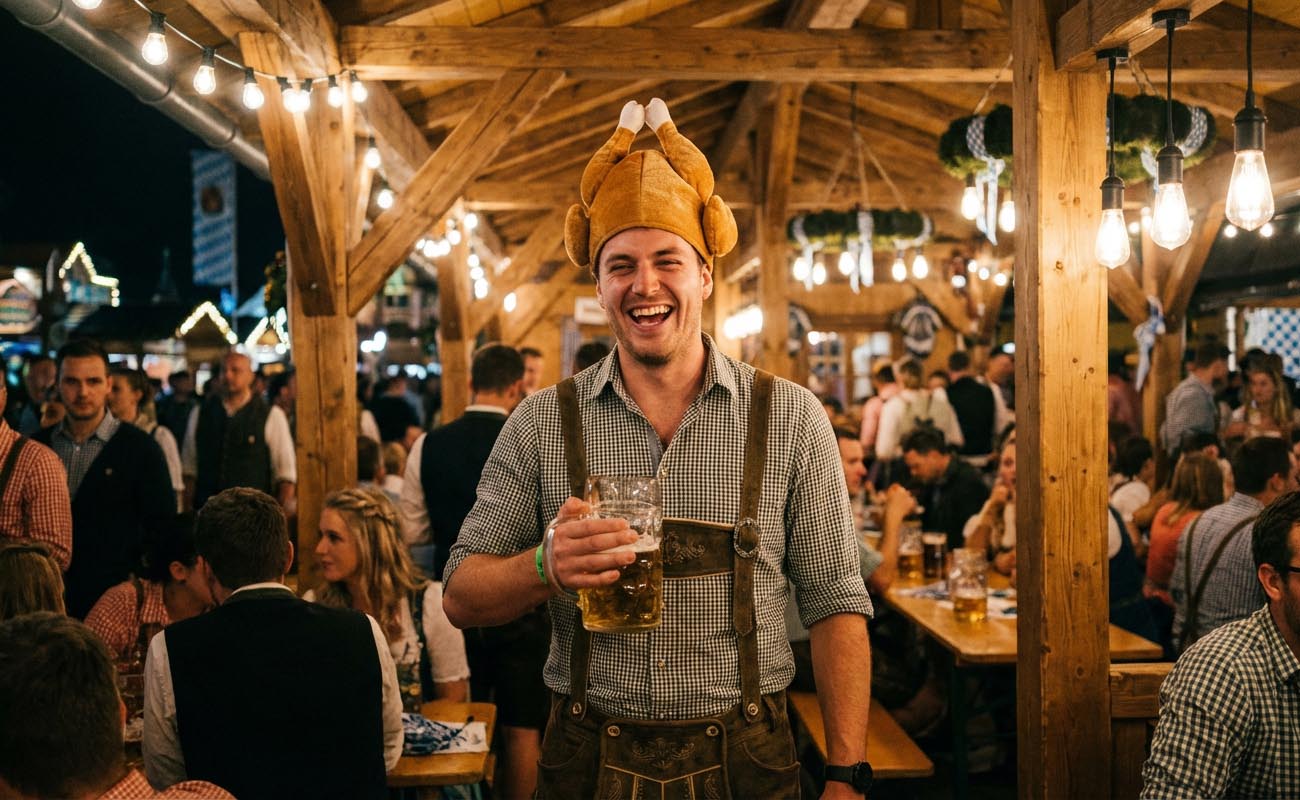
Ultimately, the phenomenon of the chicken hat proves that Oktoberfest is big enough for everyone. It is a festival that can hold space for solemn tradition and ridiculous novelty side by side. You can sit in a tent that has been there since 1890, drinking beer brewed according to a purity law from 1516, while wearing a battery-operated chicken on your head that was invented in the 1990s.
Whether you choose to wear one or not, the Hendlhut is a reminder not to take the event—or yourself—too seriously. After all, you are in a place where grown adults stand on benches to flap their arms like birds. If you can’t beat them, you might as well join them.
So, go ahead. Buy the hat. Do the dance. Eat the chicken. Just try not to get any gravy on your felt.
Frequently Asked Questions
What is the most popular food at Oktoberfest?
The roast chicken (Wiesnhendl) is the undisputed champion. While bratwurst and pork knuckles (Schweinshaxe) are popular, the half-chicken reigns supreme with over half a million sold annually.
Is the Chicken Dance German?
Technically, no. The melody (Der Ententanz) was composed by a Swiss musician, Werner Thomas. However, it became a staple of German festivals and eventually a global Oktoberfest anthem.
Can I wear a chicken hat into any tent?
Yes, there are no strict dress codes banning novelty hats in the general admission areas of the large tents. However, you might feel out of place in the smaller, more traditional tents like the Fischer-Vroni or Augustiner-Festhalle.
Where can I buy a Hendlhut?
In Munich, you will find them at souvenir stands around the Hauptbahnhof (train station) and lining the streets entering the Theresienwiese. In the US, they are available at festival vendors and online costume shops.
